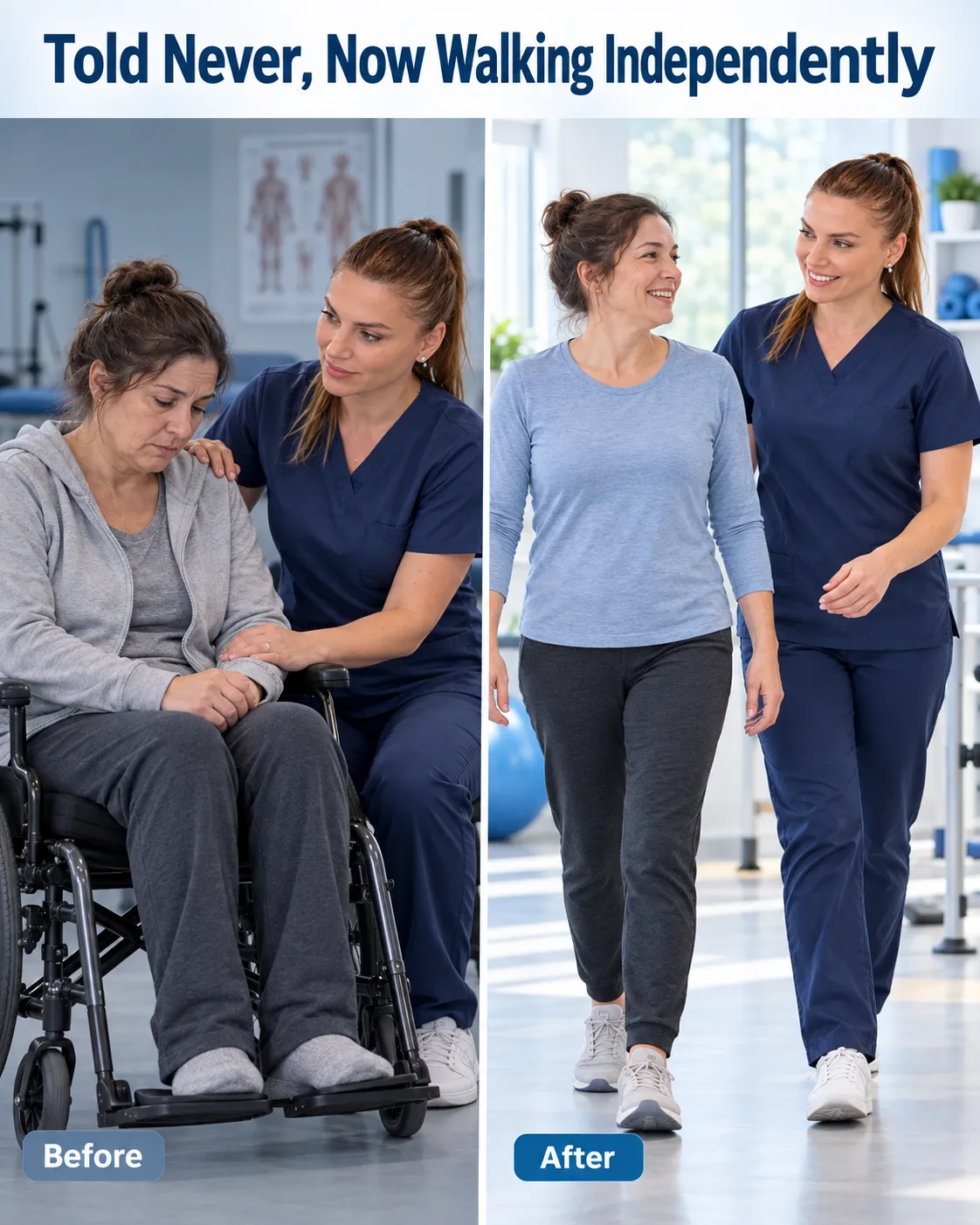
Neuro Rehab After a Plateau: What to Measure
Neuro Rehabilitation After a Plateau: What Should Be Measured Next?
Being told progress has plateaued can close down a conversation too soon. The harder question is what has actually been measured since then.
A slow week after a stroke, brain injury, spinal injury, MS or Parkinson’s does not show what the next month of specialist rehabilitation could achieve. It is a reason to reassess the problem, the goal and the treatment plan.
TL;DR
A reported plateau should prompt a review of what was measured and when.
Start with a task that matters at home, such as transferring from chair to bed or walking to the kitchen.
Set a specific goal and adjust treatment as ability changes.
Use suitable measures to track progress, while checking whether daily tasks are becoming safer and more manageable.
Your browser does not support the video tag.
What Is This? (Short Answer)
Specialist neuro rehabilitation is treatment planned around how a neurological condition affects a person’s movement and daily activities. When progress appears to have slowed, the next step is to assess what the person can do now and identify a useful goal.
That goal may be a safer transfer, a few steps across the home or a turn that causes freezing. The task gives the assessment a clear purpose.
How does this work?
It starts by looking at the task where the difficulty happens. For someone who is housebound or bedbound, that means assessing them where those tasks take place.
Consider a person working towards a safer transfer from chair to bed. The clinician can assess that transfer, agree a specific goal and review it as the person’s ability changes. This is an example of the approach, not a reported patient outcome.
The process comparison is straightforward:
Old way: Assume the same exercises and occasional review are enough.
New way: Check the task that matters at home, set a goal and adjust treatment as ability changes.
Progress should be visible rather than inferred from encouragement alone. The 10-Meter Walk Test and Berg Balance Scale can help track walking and balance when appropriate. The practical question remains whether everyday tasks are becoming safer and more manageable.
Who is this for?
This approach is for people whose movement or daily activities are affected by stroke, brain injury, spinal injury, MS or Parkinson’s. It may be especially useful when a person or family has been told there is no more room to improve but is unsure what was last assessed.
It also matters for people who cannot easily attend a clinic. A transfer, a route through the kitchen or a difficult turn is best understood in the place where it happens.
What does it cost?
The source does not state a price for ongoing treatment. Physio Rehabilitation directs viewers to a free assessment link in the comments or bio.
Use that first conversation to ask what the assessment involves and what any recommended treatment would cost.
What are the risks?
The main risk is treating “plateau” as a final answer without checking the evidence behind it. If the goal, the task or the person’s ability has changed, an old plan may need reviewing.
There is also a risk in promising a particular result. An assessment can establish what is possible now and guide a plan; it cannot guarantee independent walking or any other outcome.
Key Takeaways
Ask what was measured. Find out which task or ability informed the conclusion that progress had plateaued.
Ask when it was reviewed. A slow week and a longer pattern of change are different things to assess.
Choose a meaningful task. Focus on something the person needs to do at home.
Track the right changes. Walking and balance measures may help when appropriate, alongside whether the daily task becomes safer and more manageable.
Review the plan. Treatment should respond to the person’s current ability.
Implementation Checklist
Write down the task that matters most at home.
Ask what has been measured so far and when it was last reviewed.
Agree a specific goal for that task.
Ask how progress will be checked and when the plan will be reassessed.
If leaving home is difficult, explain where the task happens and ask about assessment there.
Common Mistakes to Avoid
Taking a slow week as proof of what the next month could achieve.
Repeating the same exercises without reviewing the goal.
Relying on encouragement alone as evidence of progress.
Focusing on a test score while overlooking whether life at home is getting easier or safer.
Assuming that reassessment guarantees a particular result.
Physio Rehabilitation brings 15 years of NHS experience and HCPC-registered neuro-physio care to homes and care homes around Romford and Essex. The starting point is to assess what is possible now, then make a plan for the person in front of us.
If you have been told there is no more room to improve, ask what was measured and when it was last reviewed. Find the free assessment link in the comments or bio.